
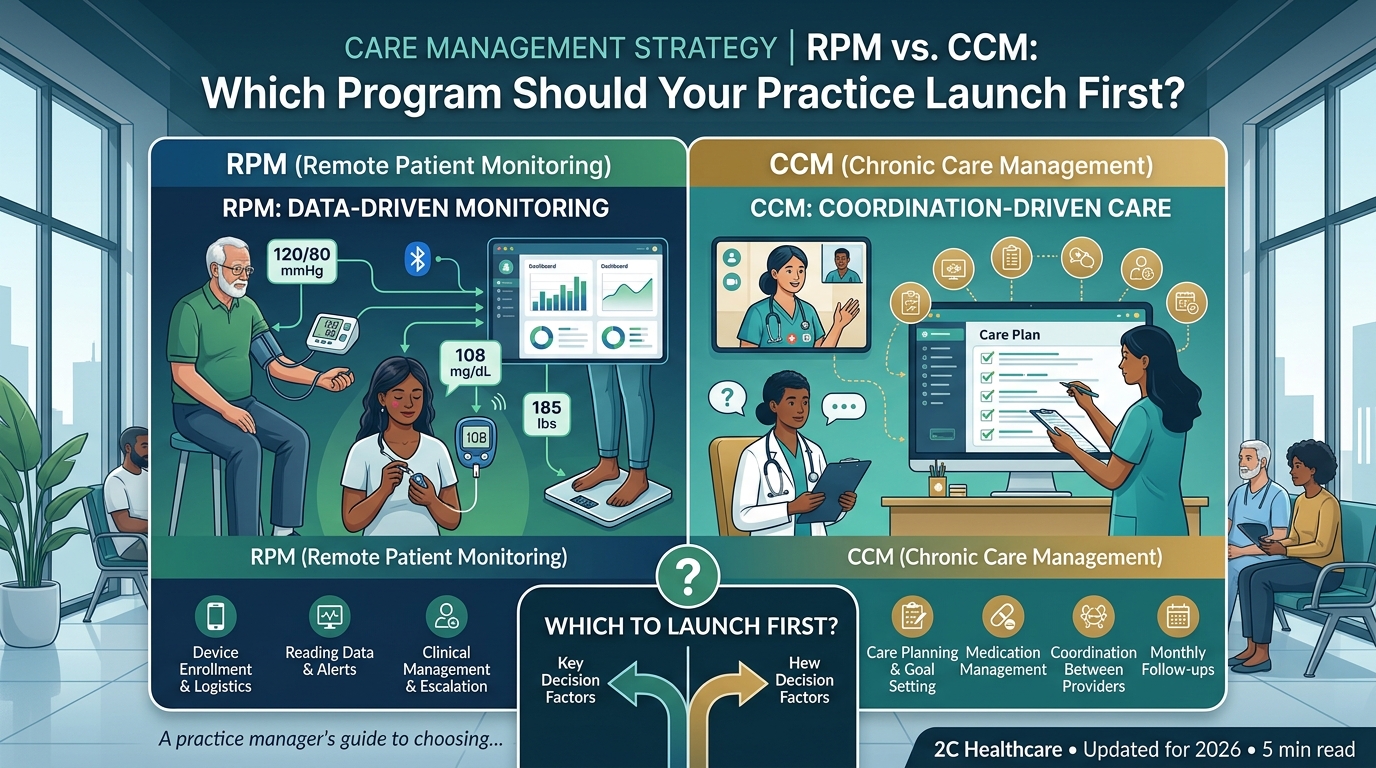
A practice manager's guide to choosing between Remote Patient Monitoring and Chronic Care Management — and knowing when to combine them.
2C Healthcare • Care Management Programs • Updated for 2026 • 5 min read
|
QUICK ANSWER RPM and CCM solve different operational problems. RPM is data-driven. It uses connected devices to collect physiologic information such as blood pressure, glucose, or weight and supports clinical management based on those readings. CCM is coordination-driven. It supports patients with chronic conditions through activities such as care planning, medication management, and coordination between providers. For some practices, RPM is the better starting point. For others, CCM may fit the patient population and existing workflows better. In appropriate circumstances, practices may use multiple care-management services for the same patient when applicable requirements are met and time is not double-counted. |
RPM in Plain English
RPM answers: “What is happening to the patient's health between visits?”
A connected device can transmit information such as blood pressure, weight, glucose, or other physiologic measurements. The care team can use that information as part of managing the patient's condition.
RPM is particularly attractive when trends in physiologic measurements are clinically useful.
CCM in Plain English
CCM answers: “What does this patient need between visits to keep their chronic conditions managed?”
CCM can involve care planning, medication management, coordination with specialists, follow-up, communication, and connecting different parts of a patient's care.
CCM does not require an RPM device.
RPM vs. CCM at a Glance
• RPM: Physiologic data, connected device, data-driven monitoring, patient communication, device logistics.
• CCM: Care coordination, care-plan management, medication and specialist coordination, patient communication, no device requirement.
The key distinction is simple: RPM focuses on remote physiologic information; CCM focuses on ongoing coordination of chronic care.
Which Should Your Practice Launch First?
Choose RPM first when your practice has a population where ongoing physiologic data can meaningfully support treatment management and you have a workflow for devices, data, patient communication, and escalation.
Choose CCM first when patients need more coordination than technology — for example, medication coordination, specialist communication, ongoing care-plan management, or follow-up between appointments.
Do not start with a program simply because it appears financially attractive. Start with the program that solves a real patient-care need your practice can operationally support.
What If Patients Need Both?
A patient may need both physiologic monitoring and broader chronic-care coordination. RPM can provide physiologic monitoring while CCM can provide broader coordination.
When multiple programs are used, practices need clear workflows showing what service is being provided, by whom, and how associated time and activities are documented. The same time or effort should not be counted twice.
|
EXAMPLE A practice has 1,000 Medicare patients. Management identifies one group that needs ongoing physiologic monitoring and another that needs broader chronic-care coordination. Rather than enrolling everyone into the same program, it creates two pathways: Physiologic Monitoring Need → RPM Coordination Need → CCM Some patients may qualify for both, subject to applicable requirements. This is more strategic than treating RPM and CCM as interchangeable products. |
The Practice Manager's Selection Checklist
Before RPM
☐ Appropriate patient population
☐ Device strategy
☐ Patient onboarding workflow
☐ Consistent data monitoring
☐ Escalation workflow
☐ Documentation process
☐ Adequate staffing
Before CCM
☐ Appropriate chronic-care population
☐ Care-plan workflow
☐ Coordination capacity
☐ Documentation process
☐ Time-tracking process
☐ Monthly operational workflow
The Biggest Mistake: Choosing Based on Revenue Alone
Care-management programs should not begin with: “Which program pays more?”
Start with: “Which program solves a real patient-care need that our practice can operationally support?”
The strongest programs connect:
|
Patient Need → Program → Workflow → Staff → Documentation → Clinical Action |
|
BOTTOM LINE RPM measures what is happening between visits. CCM coordinates what needs to happen between visits. The right program is the one that matches your patients' needs — and your practice's ability to deliver it consistently. |
Frequently Asked Questions
Is RPM the same as CCM?
No. RPM centers on remote collection and management of physiologic data, while CCM focuses on ongoing chronic-care coordination.
Can RPM and CCM be used for the same patient?
They may be used concurrently when applicable requirements are met and time and effort are not improperly counted twice.
Does CCM require a device?
No. CCM is fundamentally a care-coordination service and does not require an RPM device.
Should a small practice start with both?
Not necessarily. Start with the program that best matches the patient population and the practice's operational capacity, then expand once the workflow is reliable.
This article is for general informational purposes and does not constitute billing, legal, or medical advice. Medicare requirements, payer policies, and coding rules can change. Consult qualified billing and compliance professionals